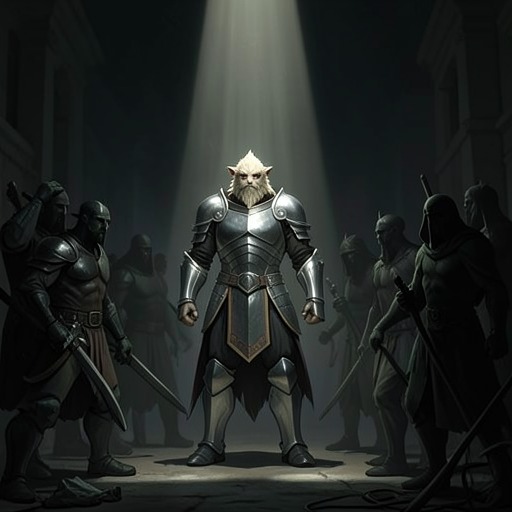
Freely they stood, and fell who fell
Paradise Lost“Freely they stood, and fell who fell” is a compact statement of the moral architecture of Paradise Lost. It distinguishes freedom from mere exemption from authority: created beings are free because they can reason, choose, obey, and fall. The expression therefore makes rebellion a self-authored act rather than the unavoidable result of fate, divine compulsion, or an imposed necessity, while allowing the poem to explain why judgment can be just and why voluntary obedience can possess genuine value.
Definition and Immediate Context
The expression occurs in God’s account of the creation and revolt of the celestial powers. Looking upon Heaven, Earth, and Satan’s approach toward the newly created world, God explains to the Son that the adversary will attempt to destroy or corrupt Man, and that Man will fall through deception. God then asks whose fault the fall will be and answers that the responsibility belongs to the one who acts wrongly, because he was created “just and right, Sufficient to have stood, though free to fall.” The immediately associated formulation, “Freely they stood who stood, and fell who fell,” presents standing and falling as alternative acts performed by beings endowed with liberty.
The wording joins two symmetrical conditions. Those who remain faithful do not merely happen to remain upright, while those who rebel are not merely swept away by an external force. Both outcomes arise within a field of freedom. The parallel syntax gives the principle an almost judicial balance: standing and falling are different results, but each is connected to the will of the agent who experiences it.
Freedom Against Necessity and Predestination
God develops the expression by arguing that compulsory obedience would have no moral significance. If the celestial powers had been unable to do otherwise, their apparent allegiance would have been only the operation of necessity, not an expression of “true allegiance, constant Faith or Love.” Will and reason would have been rendered useless if they could perform only what they were forced to perform. Freedom is thus not an ornamental privilege added to created existence; it is the condition that makes praise, love, loyalty, and blame intelligible.
The argument also rejects the claim that foreknowledge causes the revolt. God declares that the rebels themselves decreed their own revolt and that foreknowledge had no influence upon their fault. Their actions would have remained their own even if they had not been foreknown. The expression consequently separates certainty of divine knowledge from causation: an act may be known in advance without being compelled by the knower.
This distinction supports the poem’s theodicy. Since the fallen powers are “Authors to themselves” in what they judge and choose, they cannot justly accuse their Maker, their making, or their fate. Their fall does not arise from an immutable decree forcing them into evil. They were made free, and they remain free until they enthrall themselves. Freedom therefore carries its own burden: the power to choose is also the possibility of self-enslavement.
Political and Theological Reversals of Liberty
The principle becomes dramatically contested in the debate over authority. Satan presents equality and liberty as grounds for resisting the Son’s kingship. He argues that beings who are free and equal should not bend the knee to a monarch, and he treats divine law as an illegitimate yoke. His rhetoric converts political liberty into a weapon against rightful order, especially when he claims that the heavenly powers were made to govern rather than serve.
Abdiel answers that orders and degrees do not necessarily destroy liberty. In his view, service becomes servitude when directed toward the unwise or the unworthy, but serving the one whom God ordains and who is worthiest to rule is not degradation. The Son’s authority, as Abdiel presents it, does not obscure the glory of the angels; it unites and enlarges it under a rightful head. The poem thus distinguishes freedom from the refusal of every superior authority. Liberty is compatible with obedience when obedience accords with reason, nature, and legitimate worth.
Satan’s own position exposes the danger in his language. He condemns service as slavery while gathering followers beneath his command and pursuing a kingdom in Hell. His claimed liberation becomes a new hierarchy centered on his own will. Abdiel therefore identifies Satan as not truly free but “to thy self enthrall’d.” The expression’s logic turns against Satanic rhetoric: a being ruled by pride and appetite may oppose an external sovereign while remaining internally dominated by self-love.
The same political reversal appears in Michael’s account of human history. After the Fall, true liberty is lost because right reason is obscured or disobeyed; disordered desires and passions seize government within the person and reduce the formerly free human being to servitude. External tyranny follows as a judgment upon this internal disorder, though the tyrant receives no excuse from the victim’s corruption. Human political domination therefore mirrors the poem’s larger distinction between rightful rule and self-imposed bondage.
Human Freedom, Disobedience, and Grace
The expression applies not only to the celestial rebellion but also to human action. God creates Adam and Eve in his image, gives them reason, and assigns them dominion over the created world. Their freedom is marked by a single prohibition: they may eat freely from the garden’s trees except the Tree of Knowledge of Good and Evil. The command establishes a concrete test through which obedience can be more than instinctive compliance. Because Adam and Eve can choose otherwise, their fidelity would have moral substance.
When Eve eats the Forbidden fruit, Adam understands that the act has brought ruin, yet he chooses to share her fate. His decision does not erase the earlier freedom of the act. He recognizes the transgression as a breach of the command, but love and the bond of one flesh lead him to accept the same doom rather than live without Eve. The scene gives the principle a tragic human form: freedom is not abstract autonomy but the capacity to make a choice whose consequences reach the self, the beloved, and the whole human line.
God’s treatment of the fallen angels and humanity introduces a further distinction. The first celestial rebels fall through self-temptation and self-depravation, whereas Man falls deceived by the other. For this reason, God declares that Man will find grace while the fallen powers will find none. Freedom establishes responsibility, but the manner of the fall affects the operation of mercy and justice. The expression does not mean that every fall receives the same consequence; it identifies the agency behind the fall while leaving room for differentiated judgment.
Redemption and the Completion of the Principle
The consequences of freedom culminate in the need for redemption. Human disobedience breaks fidelity to Heaven and leaves death as the penalty. No created being in Heaven steps forward to pay the debt on humanity’s behalf. The Son of God alone offers life for life, accepting incarnation, mortal suffering, and death so that the penalty may be borne and humanity may be restored.
The Son’s voluntary offering is essential to the poem’s moral structure. Redemption is not another form of compulsion: the Son freely gives up his glory, enters the human condition, and accepts death, while God’s justice remains satisfied. Through obedience and love he fulfills the Law that Adam failed to fulfill. His merit may be imputed to those who receive redemption by faith, so that the freedom implicated in the Fall is answered by a freely embraced obedience that opens the way to restoration.
The expression consequently participates in the poem’s larger contrast between Fall and Restoration. Adam’s descendants inherit guilt through the first human root, while those restored through the Son receive new life from a second root. Satan’s apparent victory produces neither final mastery nor the annihilation of creation. The Son’s death wounds Death, defeats Sin and Death as the adversary’s principal powers, and leads toward resurrection, ascension, judgment, and the renewal of Earth as a happier Paradise.
Significance in the Poem
“Freely they stood, and fell who fell” condenses the poem’s answer to the problem of evil into a memorable antithesis. A world populated by rational creatures must permit meaningful choice; without that freedom, obedience would be empty, love would be mechanical, and praise would be undeserved. Yet freedom also makes rebellion possible and allows creatures to turn their liberty into self-rule, pride, and bondage.
The expression therefore stands between two rival conceptions of liberty. One is the liberty of rational creatures ordered toward the highest good, capable of voluntary obedience and sustained by right reason. The other is Satan’s counterfeit liberty, which equates freedom with equality against all authority and finally produces domination, faction, and servitude to the self. The poem’s decisive claim is that falling freely does not make the fall just, but it does make the judgment intelligible; and because humanity’s fall involves deception as well as choice, justice can be joined to mercy through the Son’s voluntary sacrifice.